There are no items in your cart
Add More
Add More
| Item Details | Price | ||
|---|---|---|---|
Like every year, admissions to super speciality courses have once again been delayed due to ongoing court cases. While some first-year residents have already joined, many are still waiting to begin what will probably be one of the most transformative phases of their professional lives. The transition into the fascinating world of plastic surgery is always special. Watching the younger entrants into the specialty often makes me nostalgic and sends me into flashbacks of my own residency days. It makes me think how the training, exposure, and the specialty itself have evolved over the past two decades and more.
Although some might differ with me on this, but most will agree that the disproportionate number of increase in seats as compared to the clinical workload at most places has adversely affected the training of the current generation of plastic surgery residents. Neither the bed strength nor the OT days have increased at most places, nor the number of faculty. This has reduced the hands-on exposure of the residents. It also to some extent has reduced the one-on-one interaction with the faculty as compared to the previous years. This blog is an attempt to share a few thoughts and insights on this issue and how to make the absolute best use of these crucial years of plastic surgery residency, or any residency for that matter.
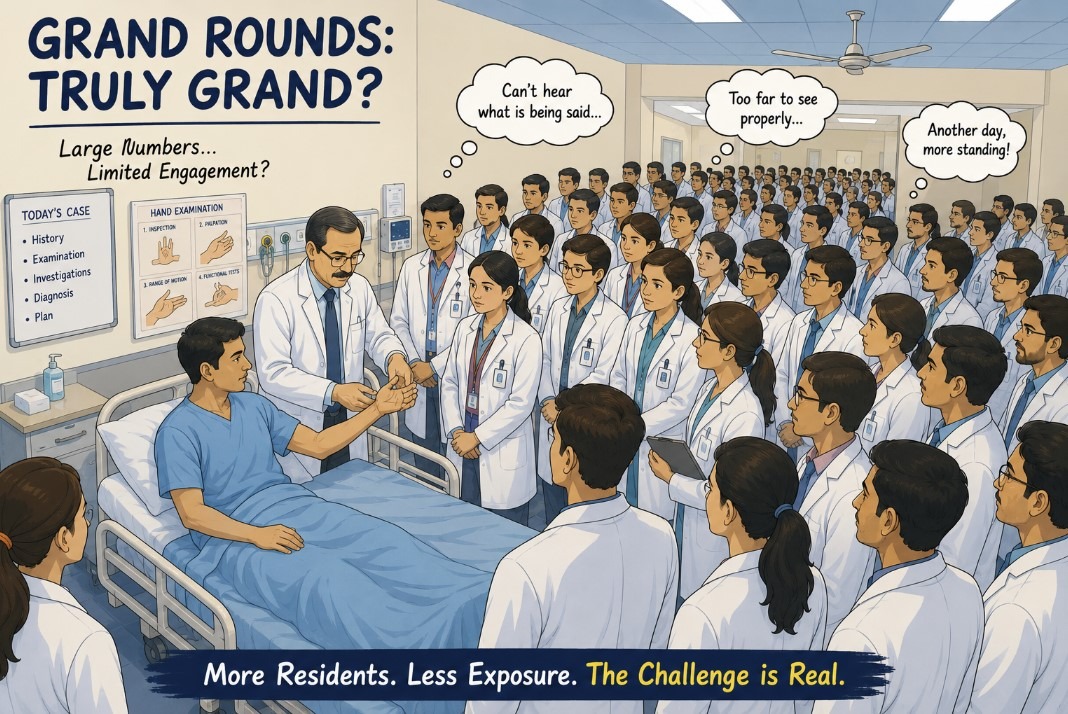
There are many ways in which the plastic surgery training is transformed, but in terms of Grand rounds, it has undergone a profound transformation over the years. Traditionally, Grand Rounds were intimate, immersive, and deeply engaging, often conducted with just one or two residents per year. These sessions allowed close bedside interaction, detailed discussions, and meaningful engagement with faculty. Today, however, at most places, the landscape has changed significantly. With eight to twelve or more residents in a batch, and then some post MCh bonded senior residents, Grand Rounds have evolved into larger and more dispersed gatherings and have become really grand in the physical sense. While the number of residents in the departments has gone up, it has inevitably reduced the depth of individual engagement during the grand rounds. Same thing is true for clinical and surgical exposure.
Rather than viewing this as a limitation, it is more useful to recognize it as a shift in responsibility from a system-driven model of learning to a more self-driven one. One of the most important realizations during residency is that no department is complete. Every unit is shaped by its case mix, faculty expertise, institutional priorities, and available resources. It is natural for residents to feel that something is missing; whether it is exposure to microsurgery, aesthetics, craniofacial work, or even structured academic time! However, plastic surgery is far too vast for any single program to cover in entirety. The purpose of residency is not to produce a finished plastic surgeon, but to build a solid foundation that allows continued growth throughout one’s career. The residency experience is defined more by the resident’s mindset than by the structure of the department itself.
Another striking aspect of training is the variability in how different faculty members approach clinical and academic work. No two consultants conduct rounds or academic interactions in the same way. Some emphasize investigations in great detail, others focus on operative planning, while some prefer lengthy discussions and others value efficiency and brevity. Initially, this variability can be confusing, especially when residents are expected to adapt quickly to different expectations. And it might be a thing of displeasure for the residents, but over time it must be understood that this diversity is not a weakness but a strength. Each faculty member represents a unique philosophy of practice, and together they offer a composite learning experience that no single individual could provide.
In this context, residency should not be approached as a passive process where one merely attends what is arranged or does what is told. It must become an active exercise in observation and assimilation. Every individual in the department, be it faculty, seniors, and even juniors has something valuable to offer. One may communicate exceptionally well with patients, another may demonstrate remarkable technical finesse, while someone else may excel in decision-making or composure during emergencies. The essence of training lies in the ability to recognize these qualities and consciously incorporate them into one’s own practice. The goal is not to imitate any one person completely, but to thoughtfully curate the best attributes from all in the department.
No special talent is needed for pursuing a Plastic surgery residency, or any residency for that matter. But it is expected that everyone of us should be good at things that takes no talent. Simple acts such as being punctual, taking preop and postop photographs of patient with a clean background, preparing before a case, reading, or watching a procedure in advance, communicating respectfully with patients and their relatives, maintaining records and being receptive to feedback do not require exceptional ability. They require no talent. They just require a reduction in social media scrolling, intent, and discipline. Yet, over time, these seemingly small habits create a significant distinction between those who merely complete residency and those who truly evolve into dependable and astute plastic surgeons.
While many residents enter training aspiring to master complex reconstructions, real-world practice often tells a different story. Unless attached to a specialised centre, for most plastic surgeons, a considerable proportion of day-to-day work involves minor burns, CLW’s, wounds, trauma, pressure sores, basic hand injuries, and common aesthetic or congenital concerns. In such scenarios, what distinguishes a good surgeon is not the technical expertise but the ability to communicate clearly, explain procedures and expectations, discuss complications honestly, and connect with patients on a human level. Communication is not an optional skill; it is central to both academic practice and private practice. The ability to listen with the intent to understand, rather than simply to respond, enhances not only patient care but also professional relationships.
There is a tendency among residents to measure their training by the number of rare or complex procedures they have performed. However, the true value of residency lies not in the volume of specific surgeries but in the depth of understanding of fundamental principles. Concepts such as tissue handling, vascularity, planning, wound management, flap physiology, tension lines, haemostasis, and postoperative care form the backbone of plastic surgery. These principles transcend subspecialties and remain relevant regardless of where and what one eventually practices. A resident who understands these deeply will always be better equipped than one who has merely observed a higher number of complex cases without grasping their underlying logic. After all, excellence in plastic surgery is often nothing more than ordinary steps performed extraordinarily well.
Ultimately, the three-year residency period is a unique and formative phase. It exists in a space where no system is perfect, no department is complete, and no individual has all the answers. This is precisely what makes it so valuable. It offers an environment rich in diversity, variability, and opportunity. The challenge is not to seek a flawless system, but to navigate the existing one with awareness and intent. And in a proactive manner!
The evolution of Grand Rounds and training…Or rather decline, however one may choose to see it reflects a broader change in medical education. But we must not let it diminish the potential of training. These times places greater emphasis on the resident’s role in shaping their own journey. By embracing variability, focusing on fundamentals, mastering communication, and consistently excelling in the small but essential aspects of practice, residents can transform these three years into a deeply meaningful and career-defining experience.
Dr.Nikhil Panse
By passion and by profession, I am a Plastic & Reconstructive Surgeon. I am deeply involved in education, research, and spreading awareness about the true scope and impact of plastic surgery. Launch your Graphy